

Weigh-In-Motion systems leverage IT infrastructure to monitor vehicle weights in real-time, enhancing data accuracy, road safety, and traffic flow management.
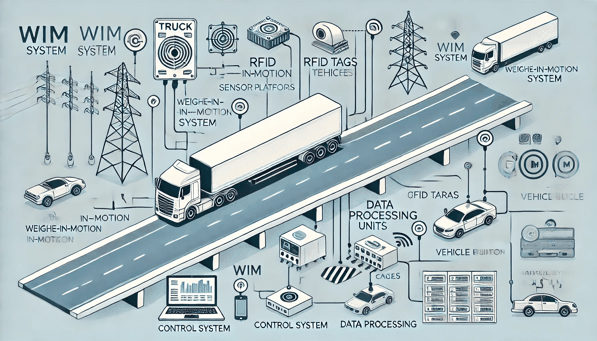
National Institute of Standards and Technology(NIST)’s Office of Weights and Measures (OWM) collaborates with states to develop standards for Weigh-In-Motion (WIM) systems. These systems use sensors and IT infrastructure to measure vehicle weights accurately and efficiently. They rely on secure data networks to transmit information to central servers for processing, ensuring that weight data is handled precisely.
Weigh-In-Motion systems can be integrated with databases to facilitate accurate record-keeping, analysis, and enforcement. Recently, NIST proposed expanding Weigh-In-Motion standards (WIM-23.1) for direct enforcement applications and participated in a testing demonstration in Wisconsin. During this event, data from multiple Weigh-In-Motion sensors were processed using advanced IT solutions, highlighting the importance of technology in these systems.
The testing demonstrated the critical role of IT infrastructure in Weigh-In-Motion systems, including data encryption and network reliability, for accurate measurements. This technology ensures that data collected from Weigh-In-Motion sensors embedded in roadways is securely transmitted and stored. The guidelines provided in NIST Special Publication 2200-05 emphasize IT systems integration in Weigh-In-Motion for monitoring axle weights, optimizing test procedures, and managing calibration.
Challenges in Weigh-In-Motion systems include:
- Determining the optimal network configurations.
- Ensuring real-time data processing accuracy.
- Deploying IT solutions to handle high-speed data traffic from dynamic measurements.
Automated calibration, speed monitoring, and secure data communication are crucial to protect the integrity of Weigh-In-Motion systems. Furthermore, emergent weigh sensor technologies will require evaluations within IT frameworks to maintain accurate performance.
The recent demonstration involved fully loaded trucks of various configurations, using IT systems to collect and analyze data from Weigh-In-Motion sensors. Observations from this testing raised new questions, including how to best use IT infrastructure for direct enforcement in Weigh-In-Motion applications, handle data during weather conditions, and guide vehicle weight enforcement agencies in implementing reliable violation thresholds.
KeyReply Uses AI for Patient Interaction at Krakatau Medika Hospital
KeyReply (KR) partners with RS Krakatau Medika to enhance patient experience with AI solutions.
Read MoreInternet Service Providers Asked to Take Part in Eradicating Online Gambling
Minister of Communication and Information Budi Arie Setiadi asked APJII to support the government in eradicating online gambling
Read Moreauto_awesome Translate from: Indonesian 69 / 5,000 Translation results Translation result ITU Dukun
Wamenkominfo Nezar Patria stated that ITU fully supports Indonesia's efforts in developing the Electronic Government System (SPBE)
Read More


Copyright © 2023 Visi Global Teknologi. All rights reserved.