
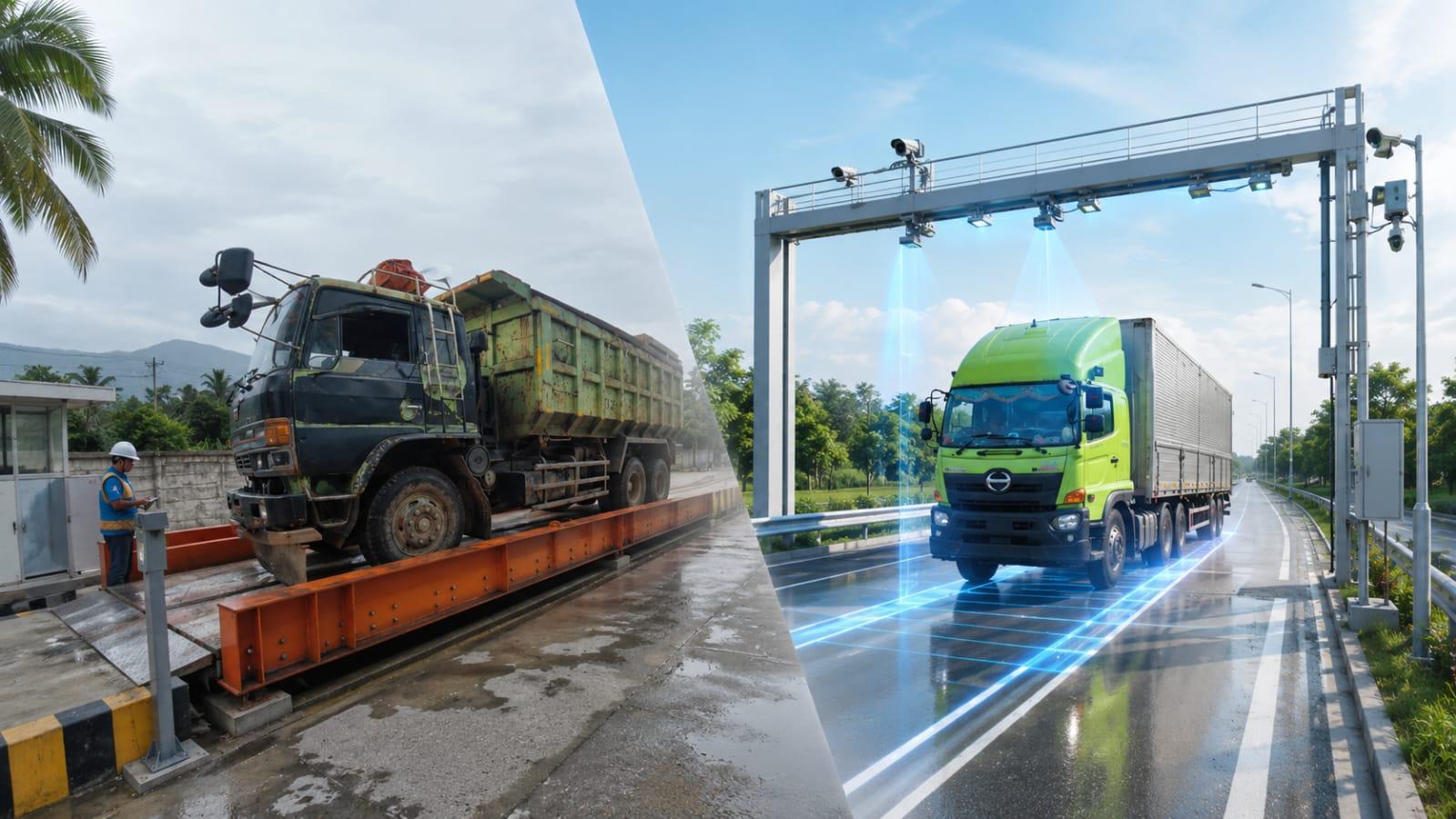
Static Weighbridge vs. Weigh in Motion (WIM): Which Solution Is Right for Your Business?
In the logistics, transportation, manufacturing, mining, port operations, industrial estate management, and road infrastructure sectors, vehicle weighing systems play a critical role in daily operations. Vehicle weight data is not only used to determine load capacity but also serves as a foundation for operational decision-making, Over Dimension Over Loading (ODOL) enforcement, infrastructure protection, and road safety improvement.
Today, two major technologies are commonly used for weighing heavy vehicles: static weighbridges and Weigh in Motion (WIM) systems, also known as dynamic weighing systems. While both technologies are designed to measure vehicle weight, they differ significantly in terms of operation, application, and business value.
As a technology company specializing in smart infrastructure and vehicle monitoring solutions, PT Visi Global Teknologi helps organizations select and implement the most suitable weighing system based on their operational requirements and long-term objectives.
What Is a Static Weighbridge?
A static weighbridge is a vehicle weighing system that requires a vehicle to come to a complete stop on a weighing platform before the measurement is taken. Once the vehicle is positioned correctly, sensors measure the total vehicle weight with a high level of accuracy.
This type of weighing system is widely used in mining operations, plantations, manufacturing facilities, cement plants, steel industries, ports, warehouses, and logistics centers. The resulting weight data is often used for commercial transactions, inventory management, operational reporting, and auditing purposes.
One of the primary advantages of a static weighbridge is its ability to deliver highly accurate and stable measurements because the vehicle remains stationary during the weighing process. As a result, static weighbridges continue to be the preferred choice for businesses that rely on weight-based transactions.
For example, industries such as coal mining, palm oil production, and bulk material transportation often use static weighbridges to determine the exact weight of products being shipped or received. Accurate measurements directly impact billing, invoicing, and revenue calculations.
What Is Weigh in Motion (WIM)?
Weigh in Motion, commonly known as WIM, is a technology that measures vehicle weight while the vehicle is moving. Unlike traditional weighbridges, WIM systems eliminate the need for vehicles to stop during the weighing process.
WIM technology is specifically designed for locations with high traffic volumes where rapid vehicle monitoring is essential without disrupting traffic flow. It is commonly implemented on toll roads, national highways, industrial zones, logistics terminals, ports, and vehicle inspection checkpoints.
Modern WIM systems are capable of measuring gross vehicle weight, axle loads, vehicle speed, axle configuration, and other operational data. They can also be integrated with Automatic Number Plate Recognition (ANPR) cameras, RFID systems, dimension measurement sensors, traffic management systems, and centralized monitoring dashboards.
PT Visi Global Teknologi provides advanced WIM solutions that can be customized to meet various operational requirements, including vehicle monitoring, ODOL enforcement, traffic analysis, and intelligent transportation management.
Key Differences Between Static Weighbridges and WIM Systems
The most significant difference between static weighbridges and WIM systems lies in the weighing method itself. Static weighbridges require vehicles to stop completely before measurement, while WIM systems perform measurements while vehicles continue moving.
From an operational perspective, static weighbridges are ideal for official weight verification and commercial transactions. In contrast, WIM systems are better suited for large-scale vehicle monitoring, traffic management, and overload detection.
Static weighbridges generally provide higher measurement accuracy because external factors such as vehicle movement are eliminated. WIM systems, on the other hand, prioritize speed, efficiency, and continuous monitoring capabilities.
In simple terms, static weighbridges are designed for weight validation, while WIM systems are designed for vehicle screening, monitoring, and data collection.
When Should Businesses Choose a Static Weighbridge?
A static weighbridge is the preferred solution when vehicle weight data serves as the basis for commercial transactions, inventory control, or official reporting.
Industries that commonly benefit from static weighbridges include:
- Mining operations
- Palm oil plantations
- Cement manufacturing
- Steel production facilities
- Ports and cargo terminals
- Warehousing and distribution centers
- General manufacturing industries
For example, a truck may be weighed before loading, then weighed again after loading. The difference between the two measurements determines the net cargo weight, ensuring accurate billing and inventory tracking.
Static weighbridges are also suitable for organizations that require printed weighing tickets, ERP integration, financial reporting, and audit documentation.
Because of their accuracy and reliability, static weighbridges remain a key component of many industrial operations around the world.
When Should Businesses Choose WIM?
WIM becomes the better option when the primary objective is monitoring a large number of vehicles without creating congestion or operational delays.
This technology is particularly valuable for:
- Toll road operators
- National highway authorities
- Industrial estate managers
- Logistics hubs
- Ports with high vehicle traffic
- Vehicle inspection stations
- Transportation authorities
By using WIM technology, operators can identify potentially overloaded vehicles without forcing every vehicle to stop for inspection. This significantly improves operational efficiency while maintaining effective oversight.
For toll road operators, WIM provides valuable data about heavy vehicle traffic patterns and infrastructure usage. For industrial estate managers, WIM helps monitor incoming and outgoing logistics vehicles without disrupting transportation flow.
Another major advantage is the ability to generate historical reports, traffic analytics, overload statistics, and real-time vehicle monitoring data through centralized dashboards.
PT Visi Global Teknologi offers integrated WIM solutions that enable organizations to transform vehicle monitoring into a data-driven operation supported by real-time insights and automated reporting.
Can Static Weighbridges and WIM Systems Be Used Together?
Yes. In fact, combining static weighbridges and WIM systems is often considered the most effective approach for modern transportation and logistics operations.
In this setup, the WIM system serves as an initial screening tool. Vehicles suspected of exceeding legal weight limits can then be directed to a static weighbridge for detailed verification.
This approach provides several advantages:
- Reduced vehicle queues
- Faster traffic flow
- Improved operational efficiency
- Accurate weight validation
- Better resource utilization
- Enhanced compliance monitoring
By integrating both technologies, organizations can benefit from the speed of WIM and the precision of static weighbridges simultaneously.
PT Visi Global Teknologi has the expertise to design and implement integrated weighing ecosystems that combine static and dynamic weighing technologies into a single monitoring platform.
Factors to Consider Before Making an Investment
Before selecting a vehicle weighing solution, organizations should carefully evaluate several key factors.
The first factor is the primary purpose of the system. Will it be used for commercial transactions, traffic monitoring, overload enforcement, or a combination of multiple objectives?
The second factor is daily traffic volume. Facilities handling large numbers of vehicles often benefit more from WIM technology due to its ability to process vehicles without stopping them.
The third factor is accuracy requirements. If weight measurements directly affect financial transactions, static weighbridges remain the preferred choice.
The fourth factor involves site conditions and infrastructure readiness. Some locations may require advanced integrations such as license plate recognition cameras, vehicle dimension sensors, automated reporting systems, and centralized control platforms.
Budget considerations, future expansion plans, maintenance requirements, and regulatory compliance should also be evaluated before making a final decision.
Conclusion
Static weighbridges and Weigh in Motion systems serve different purposes, but they complement each other exceptionally well. Static weighbridges excel in accuracy and transaction-based applications, while WIM systems provide superior efficiency, speed, and real-time vehicle monitoring capabilities.
Organizations that require certified weight measurements for commercial transactions should prioritize static weighbridges. Meanwhile, organizations responsible for monitoring large volumes of vehicle traffic can gain substantial benefits from implementing WIM technology.
In many cases, the most effective solution is a combination of both technologies. By integrating static and dynamic weighing systems, businesses can improve operational efficiency, enhance compliance, reduce congestion, and gain valuable insights from vehicle data.
With extensive experience in intelligent transportation and infrastructure solutions, PT Visi Global Teknologi is committed to helping logistics companies, industrial estate operators, port authorities, toll road operators, and government agencies implement reliable, accurate, and future-ready vehicle weighing systems that support long-term operational success.
ChatGPT Can Now See, Hear and Talk
OpenAI launched a new feature on ChatGPT that enables voice and image interaction, providing a more intuitive experience in communicating
Read MoreWIM-VISI: Smart Technology Driving Indonesia Toward ODOL-Free 2027 | PT Visi Global Teknologi
PT VGT hosts “WIM for the Future” seminar to promote Weigh-In-Motion tech supporting Indonesia’s ODOL-Free 2027. Smart, efficient, sustainable transport.
Read MoreGarmin Launches Descent G1 Solar Ocean Edition Made from Used Fishing Nets
Garmin launches Descent G1 Solar Ocean Edition made from recycled materials to preserve marine ecosystems.
Read More


Copyright © 2023 Visi Global Teknologi. All rights reserved.